
NEWS
Professional attitude and strict quality control
Aluminum extrusion forming, as a highly efficient and flexible metal processing method, occupies an important position in the manufacturing industry. From building profiles to aerospace components, aluminum extrusion is widely used in various industries, benefiting from its high plasticity, diverse processing methods, and high economic efficiency. However, to truly master the core of the aluminum extrusion process, a thorough understanding of its basic steps, influencing factors, and post-processing is necessary.
I. Detailed Steps of Aluminum Extrusion
Aluminum extrusion is a processing technology that involves heating aluminum alloys and extruding them into specific shapes using a die. To achieve a high-quality extrusion forming process, a series of steps must be carried out scientifically and systematically.
1. Raw Material Preparation
Aluminum extrusion typically uses aluminum alloy round ingots (also known as aluminum bars) as raw materials. First, a suitable aluminum alloy grade is selected based on product requirements, such as 6-series (6061, 6063) for high-strength and corrosion-resistant applications, or 7-series (7075) for the aerospace field. Subsequently, the aluminum bars need to be surface-cleaned to remove oxide layers and impurities, thereby ensuring the smoothness of subsequent processes and product quality.
2. Heating Stage
The aluminum rod needs to be heated to a suitable temperature before extrusion, generally between 450°C and 500°C. This process softens the aluminum alloy, improves its plasticity, and reduces deformation resistance during extrusion. However, it is important to note that excessively high temperatures may cause the aluminum to become too soft, affecting the quality of the finished product; therefore, precise temperature control is necessary.
3. Die Design and Preparation
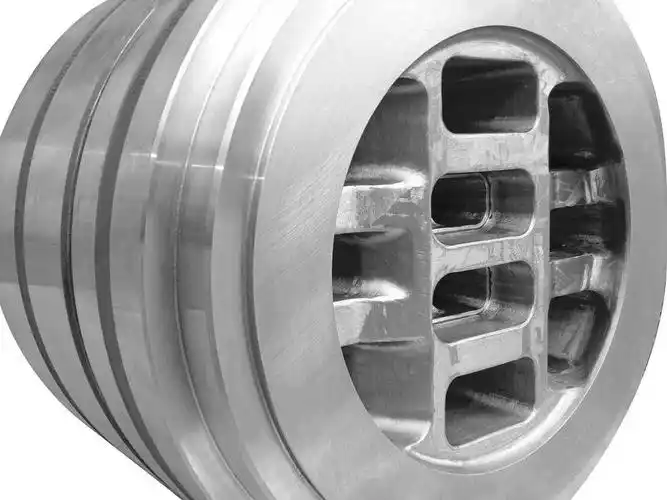
The die is the core component of the aluminum extrusion process, and its design directly affects the shape, dimensional accuracy, and extrusion efficiency of the profile. Based on the cross-sectional shape of the profile, dies can be classified as solid dies, hollow dies, and multi-cavity dies. The die needs to be preheated to a certain temperature to prevent uneven cooling of the aluminum or die damage due to temperature differences during extrusion.
4. Extrusion Forming
The heated aluminum rod is fed into the extruder and, pushed by the extrusion rod, passes through the die to form the desired cross-sectional shape. The key to this process is controlling the extrusion speed to ensure uniform aluminum flow and avoid defects such as bubbles, cracks, or warping. Furthermore, different die designs and extruder pressure parameters need to be optimized for specific products.
5. Cooling and Stretching/Straightening
Extruded profiles must be cooled immediately to rapidly reduce temperature and prevent grain coarsening and deformation. Air cooling or water cooling is typically used, depending on the type of aluminum alloy and profile requirements. After cooling, the profile may slightly bend due to internal stress; in this case, it needs to be straightened using stretching equipment to ensure dimensional accuracy and shape stability.
6. Cutting and Post-Processing
The straightened aluminum profiles are cut to specified lengths, typically 8-21 feet (approximately 2.4-6.4 meters). After cutting, the profiles are sent to an furnace for aging treatment to achieve the desired heat treatment state (e.g., T6 or T5).
Furthermore, necessary surface treatments, such as anodizing, electrophoretic coating, or powder coating, can improve their appearance and corrosion resistance. Some applications may require further processing, such as drilling, welding, or assembly.
7. Quality Inspection and Packaging
After all processing steps are completed, a comprehensive quality inspection of the finished profiles is required, including dimensional measurement, surface inspection, and performance testing, to ensure they meet design requirements and industry standards. Finally, the profiles are packaged according to order requirements to prevent damage during transportation.
Aluminum extrusion is a multi-step, meticulous production process, where each step is crucial to the quality of the final product. From raw material selection to mold design, extrusion molding, and post-processing, each link must be closely connected and precisely controlled.
II. Factors Affecting the Aluminum Extrusion Process
Although the individual steps of the aluminum extrusion process seem simple and highly automated, it is actually very complex, involving several parameters that require meticulous management.
1. Extrusion Speed
Extrusion speed is generally proportional to the temperature and metal pressure within the container. Only by properly matching speed, temperature, and pressure can process stability be maintained and consistently high-quality extruded profiles produced. Excessive speed may lead to uncontrolled metal flow, while insufficient speed reduces production efficiency.
2. Extrusion Ratio
The extrusion ratio is an important indicator for measuring the degree of mechanical deformation during the extrusion process. A low extrusion ratio generally means less metal deformation and lower production difficulty; while a high extrusion ratio requires higher pressure to force the metal through a smaller die opening, thus increasing forming difficulty and equipment burden.
3. Billet Temperature
Controlling the billet temperature is a key factor in ensuring extrusion quality. Appropriate temperature ensures good surface quality and dimensional accuracy of the profile, while achieving a shorter production cycle. Excessively high temperatures may cause excessive metal flow, making it difficult to enter complex and narrow areas, resulting in profile dimensions exceeding tolerances and potentially causing cracks at thin walls and sharp corners; conversely, excessively low temperatures increase metal deformation resistance, affecting process efficiency.
4. Extrusion Press Pressure
The pressure capacity of the extrusion press determines its adaptability to different profiles. Lightweight profiles typically require small extrusion presses, but for thin-walled, large-sized hollow profiles, even if they are lightweight, higher-tonnage extrusion presses are needed to provide sufficient pressure. This requirement is similar to the extrusion ratio; high-performance profiles require higher-performance equipment.
5. Shape of Extruded Profiles
The complexity of the profile directly determines the difficulty and cost of the extrusion process. Simple solid profiles are extruded faster and at a lower cost; while semi-hollow profiles are relatively more difficult and costly to extrude. The more complex the shape, the more difficult the extrusion process, and the higher the production cost.
After completing the extrusion and cooling processes, the following parameters need to be carefully monitored:
· Product dimensions and tolerances
· Microstructure of bars, tubes, or profiles
· Surface finish
· Mechanical properties
· Other special quality requirements
By comprehensively controlling these factors, the precision, efficiency, and product quality of the aluminum extrusion process can be significantly improved, thereby meeting the needs of various application scenarios.
III. Commonly Used Post-Processing Processes for Aluminum Extrusion
After the aluminum extrusion profiles are formed, they typically require a series of post-processing processes to improve their mechanical properties, surface quality, and meet specific application requirements. These processes are key steps in enhancing the use value and functionality of aluminum profiles, and mainly include the following categories:
1. Heat Treatment
Heat treatment can improve the ultimate tensile strength and yield strength of aluminum alloy profiles, especially suitable for 5000, 6000, and 7000 series aluminum alloy profiles.
• Aging Treatment: Divided into natural aging (T4 temper) and artificial aging (T6 temper). Artificial aging increases hardness and strength by heating the profile to a specific temperature and holding it for a certain time.
• Annealing Treatment: Through slow heating and cooling, internal stress is reduced, and the ductility of the material is enhanced.
2. Surface Treatment
Surface treatment processes are used to improve the appearance, corrosion resistance, and decorative properties of aluminum profiles.
• Anodizing: Forms a dense oxide film on the profile surface, enhancing corrosion resistance and wear resistance, while also providing a variety of color options.
• Spray Coating: A coating is evenly adhered to the profile surface using electrostatic spraying technology, providing excellent decorative effects and weather resistance.
• Sandblasting: Sandblasting is primarily used to remove residual oxides or impurities from the surface of profiles after heat treatment. This process creates a fine texture on the surface, providing ideal surface conditions for subsequent machining or painting operations, while giving the profile a matte finish.
3. Machining
Machining of aluminum profiles is a collection of processes used to improve their surface properties. Common methods include cutting, polishing, grinding, and sanding. Unlike chemical treatments, machining primarily achieves surface smoothing by applying mechanical force to the aluminum profile surface using abrasive media. This process lays the foundation for subsequent surface treatment operations, such as anodizing or painting.
Aluminum extrusion molding is a complex and precise production process involving multifaceted parameter control and step coordination. From billet heating and die preparation to final forming, each step is crucial to the quality and performance of the final product.
Search
Categories List
Need More Details?
Contact me for details on creating and managing design projects, project features, and services and prices
Send Message
Please fill the form correctly to send us your requirement. We respond to all enquiries within 4 business hours.